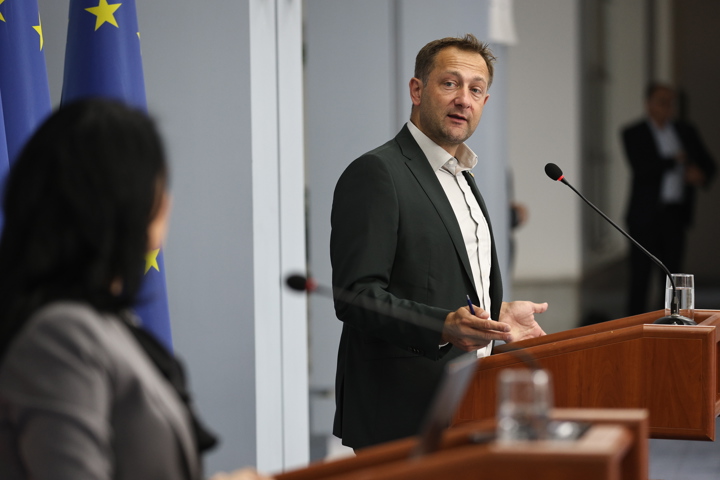
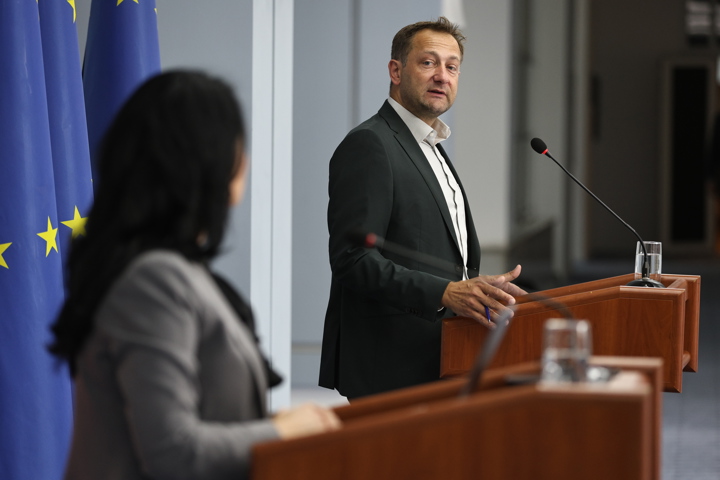
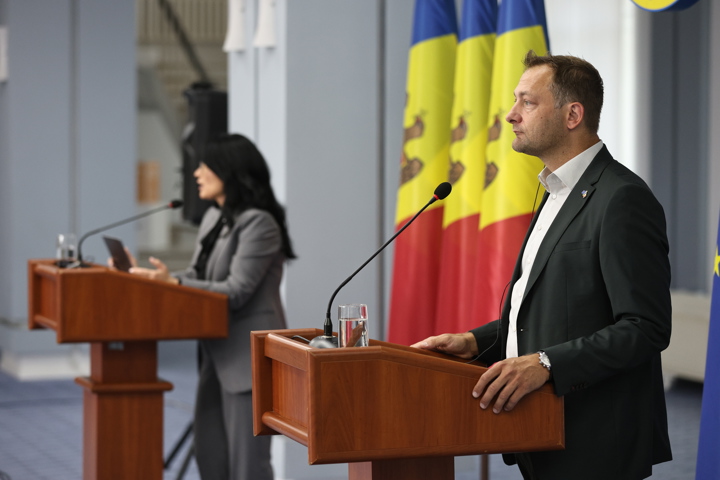
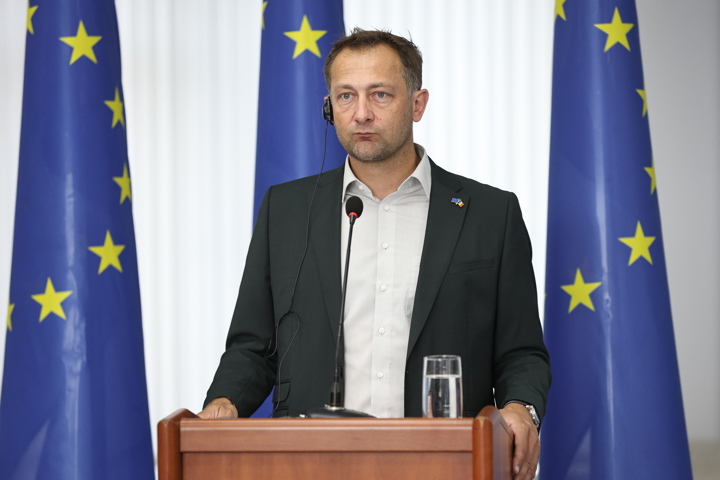
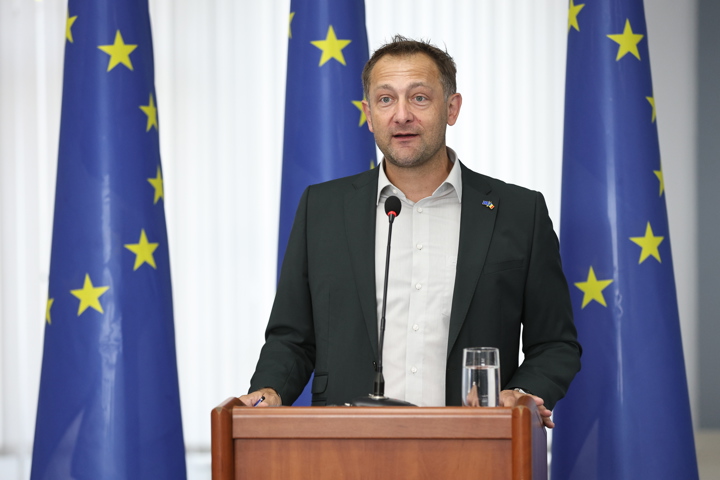
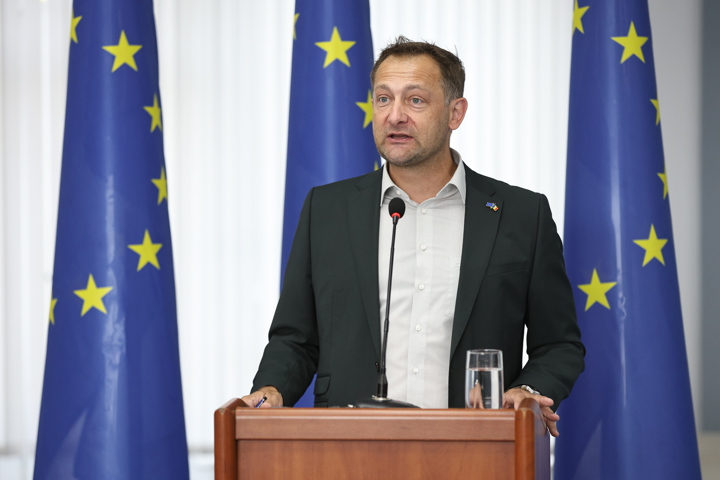
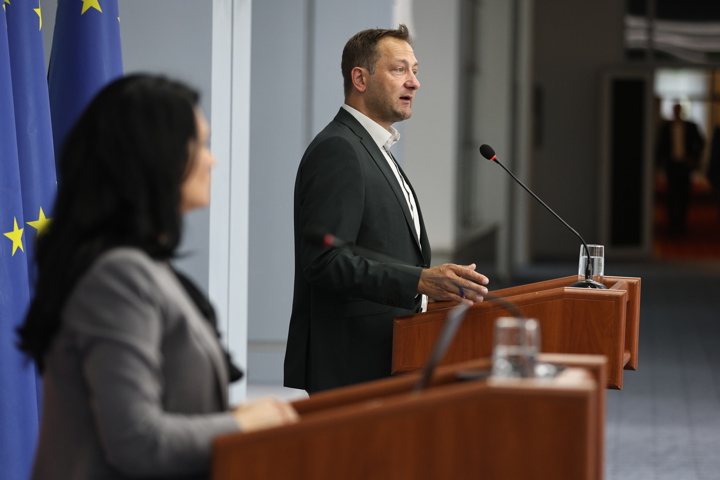
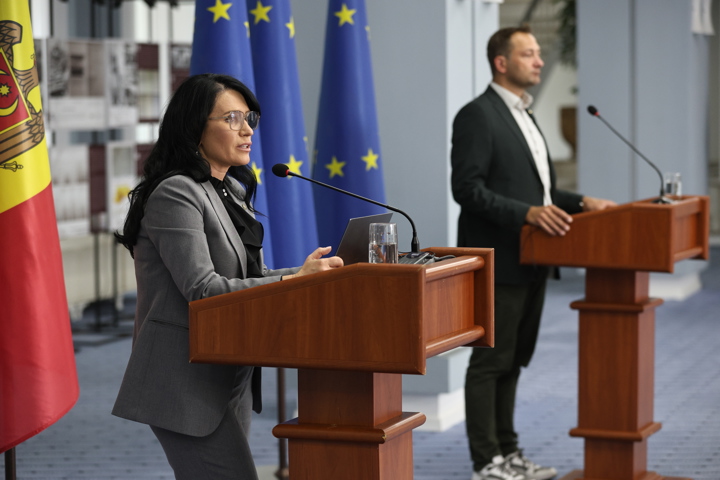
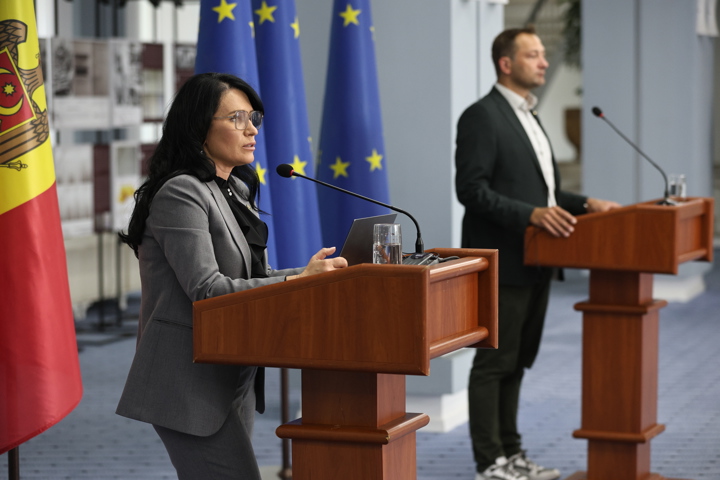
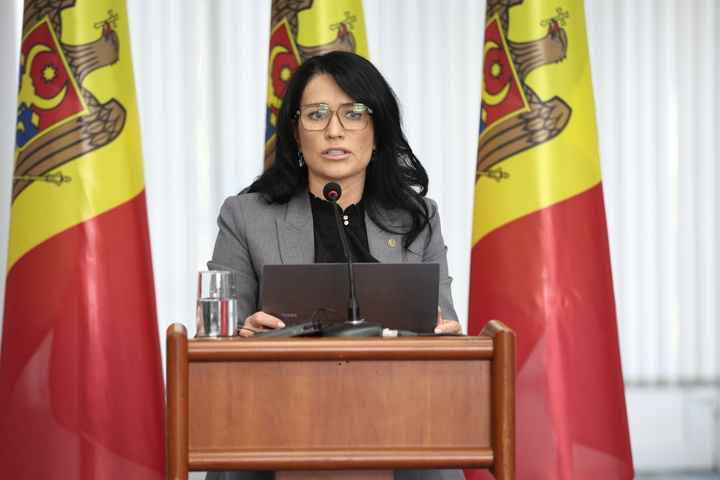
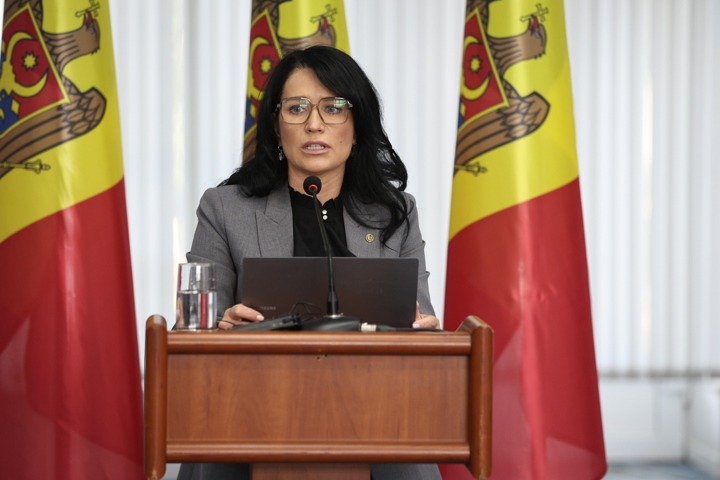
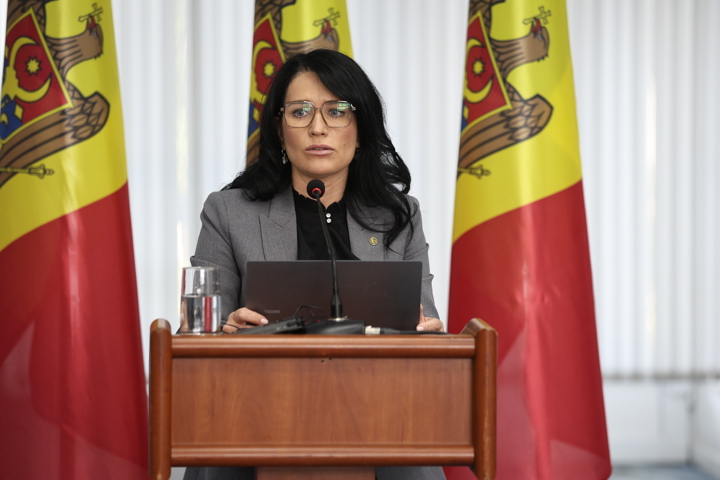
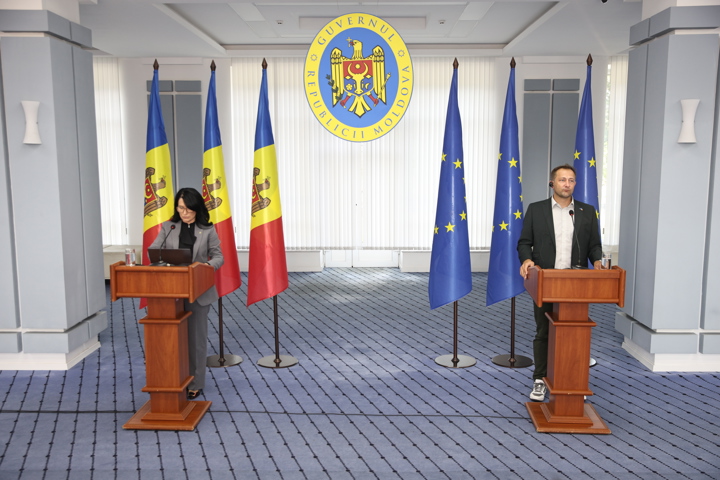
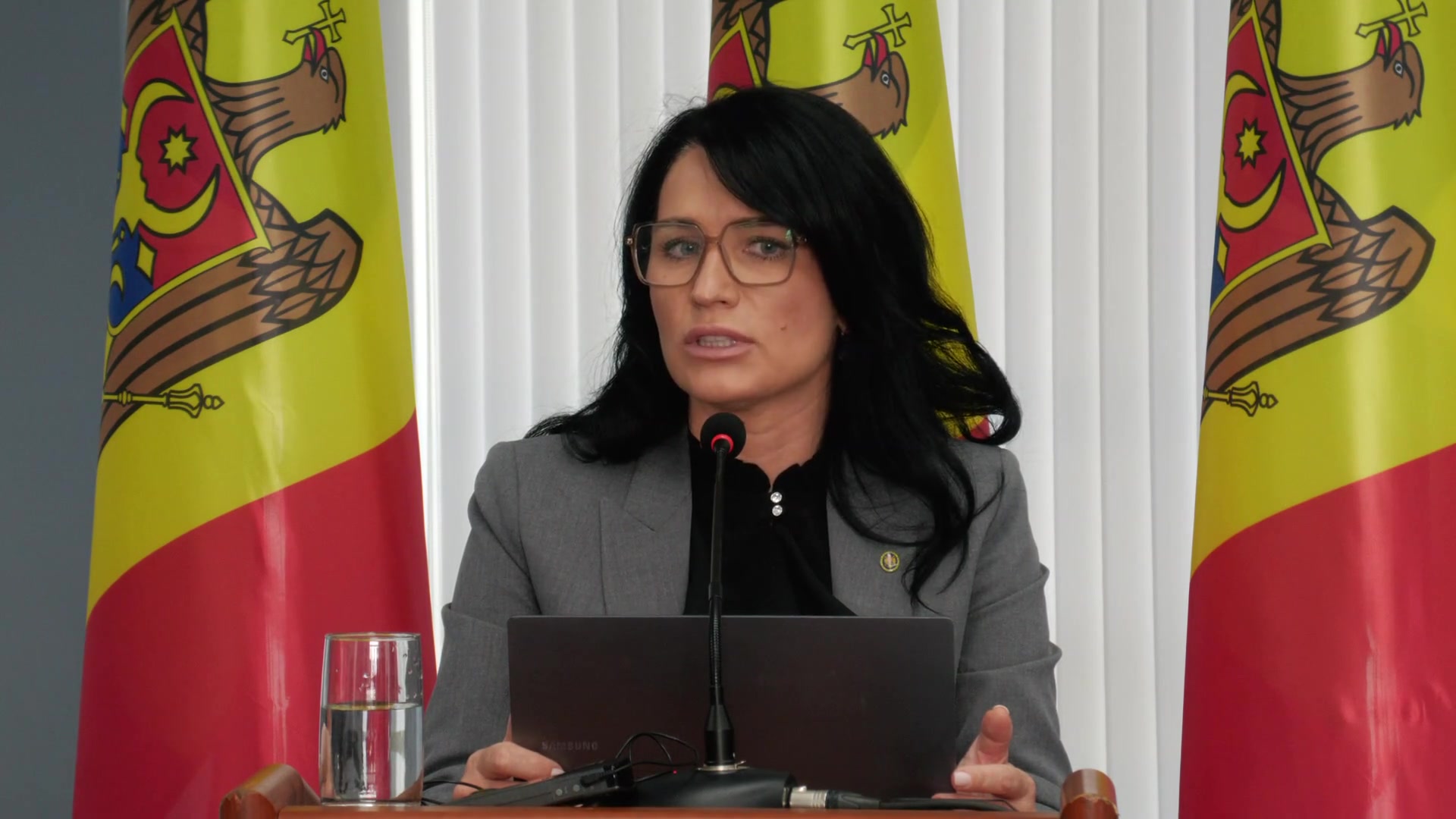
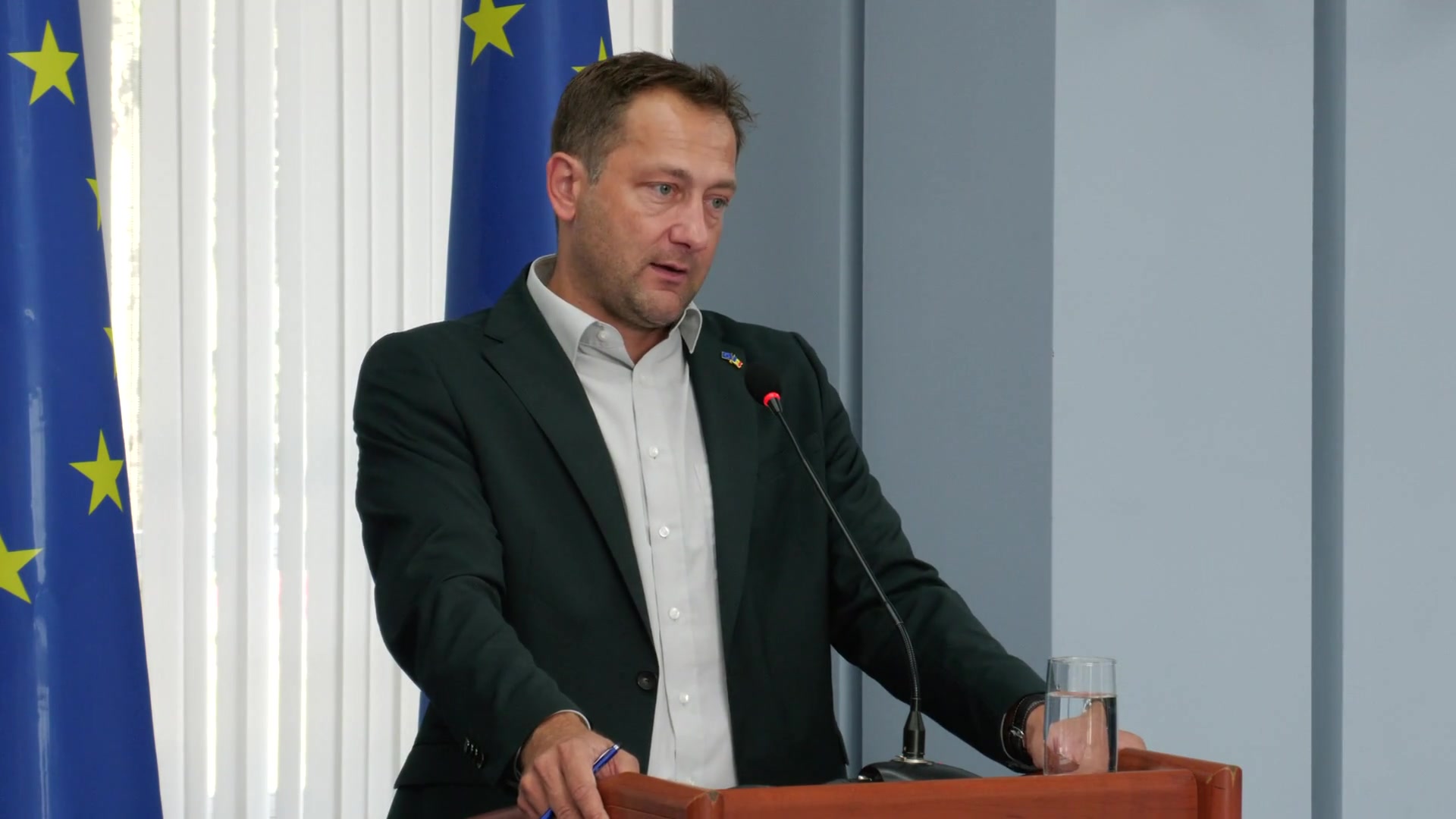
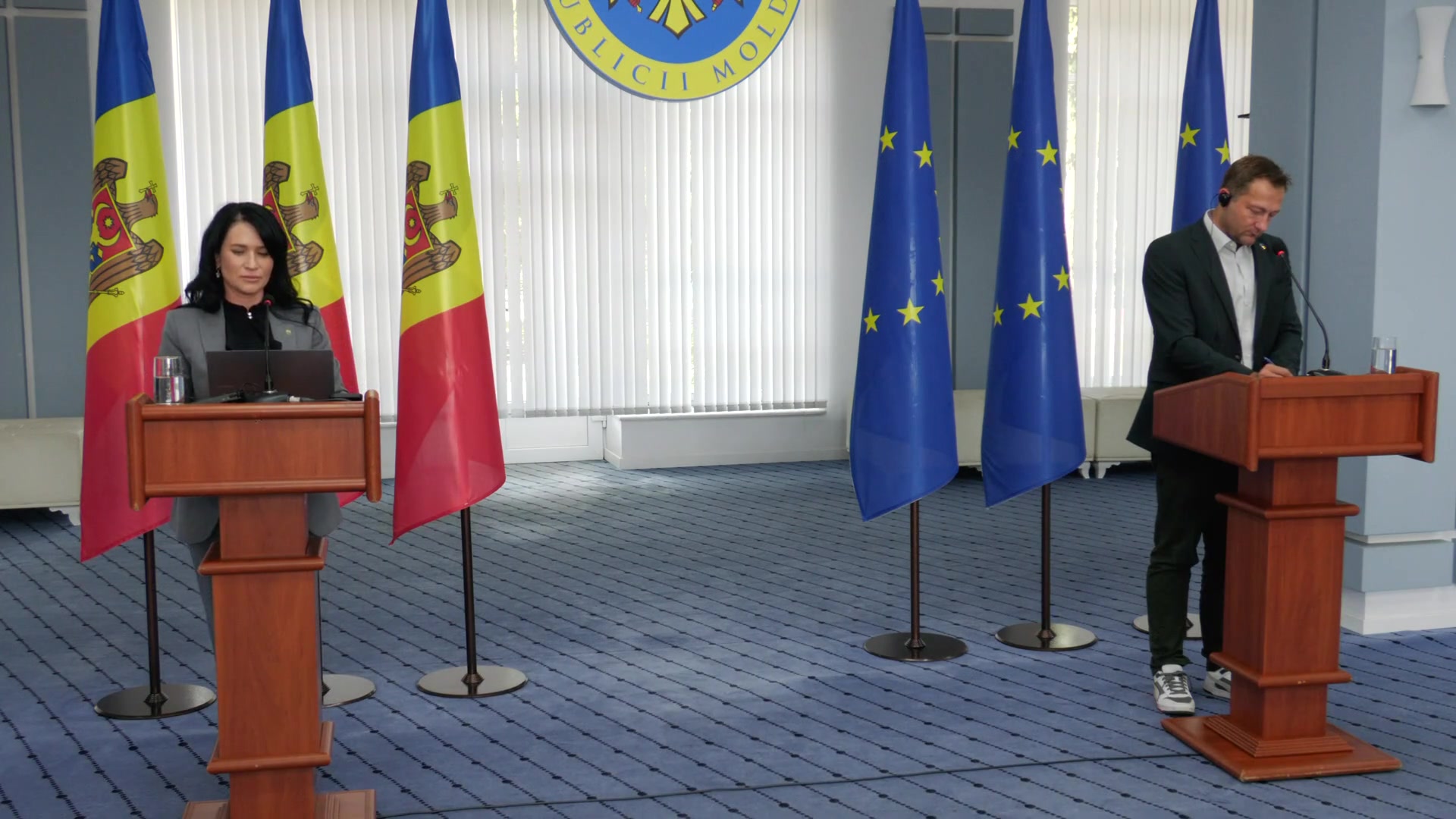
Stimați reprezentanți ai mass-media, bună ziua și bine ați venit la conferința de presă susținută de doamna Ina Butucel, secretară generală adjunctă a Ministerului Agriculturii și Industriei Alimentare, și de domnul Christophe Hansen, comisar european pentru agricultură și alimentație. Cuvânt i se oferă doamnei Ina Butucel.
[Ina Butucel]
Stimată audiență, vizita domnului Hansen este una specială și semnificativă pentru sectorul agricol. Această vizită manifestă de fapt o deschidere și o prietenie din partea Comisiei Europene, din partea Uniunii Europene și confirmă și afirmă că parcursul pe care l-a luat Guvernul Republicii Moldova în această cale de integrare europeană este unul ferm și corect.
Guvernul depune toate eforturile pentru a realiza acest obiectiv strategic cu succes, în termenele, dar și în condițiile propuse. Astăzi, țara noastră se află într-un proces amplu de realizare a acestui obiectiv ambițios de integrare în Uniunea Europeană, iar Guvernul Republicii Moldova depune eforturi enorme pentru a alinia sectoarele sale strategice la standardele Uniunii Europene.
Astăzi am avut o reuniune foarte eficientă și deschisă cu comunitatea agricolă, la care au participat exponenții sectorului agricol, asociații, producători și fermieri, care au formulat o serie de întrebări și repere pentru discuții cu comisarul Hansen. În cadrul acestor discuții au fost abordate, pe de o parte, acele aspecte care țin de îngrijorările și preocupările fermierilor în calea de a se alinia la standardele și rigorile Uniunii Europene.
Pe de altă parte, desigur, au fost abordate acele oportunități pe care le deschide Uniunea Europeană pentru Republica Moldova, odată devenită membră al Uniunii Europene. Totodată, a fost reiterat angajamentul Ministerului Agriculturii și Industriei Alimentare de a rămâne ferm în acest parcurs și de a continua să implementeze reforme importante și necesare în sectorul agricol, astfel încât să fim aliniați standardelor Uniunii Europene.
Să continuăm să asigurăm și să transpunem achi-ul comunitar în sectorul agroalimentar, astfel încât să fim cerți că toate acele norme și standarde comunitare sunt preluate de legislația noastră și asigurăm această convergență a sectorului cu cele stabilite în Uniunea Europeană. Un alt angajament pe care l-am asumat este de a transforma Moldova într-o regiune rurală mai competitivă și mai atractivă pentru a locui.
Avem și angajamentul de a continua eforturile de a liberaliza piața pentru produsele noastre, dar și de a lansa unor mecanisme transparente de finanțare a sectorului agricol, astfel încât acest suport să fie mai accesibil pentru fermierii noștri. Totodată, am reiterat că suntem în plină demarare a unui proces amplu de digitalizare a agriculturii, ceea ce va permite sau va oferi fermierilor soluții mai moderne și eficiente, atât de gestionare a fermelor lor, dar și de sporire a competitivității și rezilienței produselor lor.
Angajamentul ferm rămâne și pe partea ce ține de consolidarea infrastructurii rurale, cu investiții semnificative atât din partea Uniunii Europene, dar și a Republicii Moldova, astfel încât să fim orientați spre un impact considerabil asupra creșterii vieții comunităților rurale. Parcursul european al Republicii Moldova este nu doar o opțiune politică, ci este și o investiție în viitorul nostru european. De aceea, privim cu încredere acest proces și, totodată, sprijinul constant pe care îl avem din partea Uniunii Europene.
Aici ne referim nu doar la investiții, dar și la accesul la acel know-how, la expertiză și experiență pe care ne-o oferă colegii din Uniunea Europeană, dar și, nu în ultimul rând, la accesul la cea mai mare piață din lume. Avem convingerea că aceste procese sau transformări prin care trece sectorul agricol la moment, având în vedere procesul de aliniere la standardele și la rigorile europene, vor oferi și noi oportunități producătorilor noștri, astfel încât să îi ajutăm să creștem un sector mai competitiv, dar și recunoscut pe plan internațional.
Este momentul oportun ca să reiterăm și recunoștința noastră pentru sprijinul constant pe care Comisia Europeană îl oferă Republicii Moldova. Totodată, reiterăm că ne asumăm pe deplin acele reforme și angajamente pe care le avem propuse pentru ca să ne asigurăm că suntem aliniați cu standardele europene.
Mizăm și pe acel caracter de solidaritate și unitate a comunității agricole, astfel încât împreună să putem transforma sectorul agricol în unul competitiv, rezilient, dar și bine salutat în Uniunea Europeană. Vă mulțumesc.
Vă mulțumim. Cuvântul i se oferă domnului Christophe Hansen.
[Christophe Hansen]
Good morning, ladies and gentlemen, and first of all, I would like to thank you very much for attending this press statement. I would also like to thank Minister Catar Bluga, who was always very insistent when we met in different opportunities that I have to come to Moldova and discover firsthand, boots on the ground, the realities of the agriculture production here in Moldova, which is in my opinion very impressive from my first experience, but maybe I will come back to that.
I have had many, and I have to say, probably it's the country where I had the most high-level political meetings because I met with the Prime Minister a few weeks ago in Brussels, with the Deputy Prime Minister, with the Minister for Agriculture, but as well now with the President herself yesterday, in order to discuss, of course, our track of the cooperation that we have when it comes to figures of trade between the Republic of Moldova and the European Union, but as well on the progress of the accession to the European Union. So this was for me very important.
But first of all, I am here as well to discover the realities of the agriculture production, which has, of course, certain challenges which are challenges not only for the Moldovan agriculture sector, but also for a wider European agriculture sector. One big issue was the water issue, that we have problems to have sufficient water in order to produce in Moldova, but as well in other parts of the European Union. And I think that is something where I will also have a visit of a co-financed rehabilitation of a pumping station for water, so for an irrigation system.
And I think this is very important that we invest again into this infrastructure. Also, I visited several farms on my trip here to Moldova, mainly farms that have benefited or organizations that have benefited from European support. I visited, for example, a leading fruit production and fruit exporter. They are exporting to many EU countries, to Netherlands, to Germany, and so on, and they are benefiting already largely from this getting closer to the EU market.
Also, I visited two wineries. I visited a dairy facility, so a farm that is as well transforming and processing their milk to get as well the added value. And I think those were the very visible ones where the European Union is already having strong impacts. But also, now on my way to the water facility, we organized as well that I visit a small farm because the farming community is, of course, very diverse here in Moldova. You have very small family-based farms, but you have as well the bigger ones, and I want to have the complete picture of what agriculture means here.
I also was lucky to visit a school yesterday in Ștefan Vodă and I met a group of people, not only the pupils but also the ones that are running leader projects, which is very important for our rural areas in order to make rural areas more attractive. And of course, we just come from a meeting with the representatives of the agriculture associations, and to everyone I met, I had one clear message: the European Union is here to support you, and we are looking forward to you joining the big European community and as well, of course, the farming community.
I myself come from a farm. I'm a farmer's son and a farmer's brother, and I think that was as well felt by the farming community that I speak as well the language of the farmers because I still know how to drive a tractor and to milk a cow. And I think that is something very important to make clear to the farmers that we are here to help and that we need all of their experience to contribute as well to wider objectives. The wider objective of food security and food sovereignty is something, in my opinion, that is even more urging than ever.
Because we remember all, as well in the European Union, after the Second World War, we had famines in Europe. We didn't produce sufficient food for our citizens, and that is why the European Union and the common agricultural policy was born. And I think in the current geopolitical very tense environment, it is ever more important because we see that this food production is weaponized on a geopolitical scale. And I think this is something we need to take care of. I don't want the European continent to be dependent at some time from imports from third countries or to rely on partners that are not reliable.
And I think this reliable partner, that is exactly what the European Union stands for. And I think the EU is meanwhile Moldova's biggest trading partner. Since the provisional entry into force of the DCFTA in 2014, total trade in goods between Moldova and the EU has increased over 150%, and the share of Moldovan goods going to the EU has increased from 49% in 2014 to 65% in 2024. And I think this is quite significant.
Our revised agreement, which we just revised before the summer, even enhances this potential of mutual trade because we are liberalizing in the agriculture sector almost all the tariff lines. There are a few more sensitive ones where we just increased the level, but I think this is the intermediate step before Moldova is and hopefully will soon be joining the European Union. I'm also here to take stock of the progress that you have made on your path towards the European Union, and I can tell you this is going very good at the moment, and you are advancing at a very good pace.
When we were now with the farming associations, they also said to me, well, we need even to put the pedal to the metal to go even quicker. I hope we can do that, and the European Union stands ready to do this in joint collaboration with the national authorities where we have a very good working relationship. And I believe that Moldova is on track to becoming an EU member, and its future is for me definitely in the European Union.
Since the start of the accession negotiations, Moldova has continued to show the determination to deliver on reforms on its EU path, despite very challenging circumstances marked as well by very aggressive foreign interference. And I think the country has demonstrated very great resilience. We are very committed to advancing Moldova's accession process as swiftly as possible without compromising, of course, the quality of the reforms. And in the meantime, the Commission will continue to support the Moldovan agriculture sector.
The EU is committed to Moldova's European future, and this is a long-term strategic investment for Moldova and for the EU. And this is a choice of predictability and prosperity, reliability. And I think that is something that is very important for the farming community. A very important point, and I hear it from all the farmers all over Europe, they want to have predictability and reliability. And that is exactly what farmers will get from the European Union, a partner where you can rely.
And I think then investments and reforms can even be accelerated, and the uptake and the enhancement, and as well in the end what ends in the pocket of the farmers because they get clearly better revenues from the EU internal market than from other markets. When I talk to the farmers in the member states that I have visited so far in the nine months I went to 21 of the 27 member states, so Moldova has a little bit an advantage to several other member states that I haven't visited so far.
But the farmers always tell me, this was the next step in our development when we finally could join the European Union, that they get better revenues, that they have more strength in the value chain. And I think this is an opportunity that we need to offer to our farm and food producing society. They deserve this because we need them in order as well to guarantee this food security and this food sovereignty that we shouldn't take for granted. Therefore, we need a strong and productive farming sector, and that is what we have to work together on it. Thank you very much.
Vă mulțumim. În continuare urmează sesiunea de întrebări și răspunsuri, iar prima instituție media este bani.md.
Domnule comisar, bună ziua. În contextul în care, acum ceva vreme, săptămâna trecută, președintele Comisiei Economie, Buget și Finanțe, domnul Radu Marian, declarase că agricultura nu mai este o prioritate, n-ar mai fi o prioritate pentru Republica Moldova, în condițiile în care ar fi mai bine să se investească în servicii IT decât în agricultură, în condițiile în care aceste servicii IT aduc un mai mare randament la PIB-ul Republicii Moldova decât agricultura, care an de an e afectată de secetă. Cum credeți dumneavoastră? Este corect acest lucru, să nu mai pună accent Republica Moldova pe agricultură sau care este opinia dumneavoastră? Mersi.
[Christophe Hansen]
Well, I'm of course not here to comment on comments that I haven't heard, so I will refrain from that. But I would say, generally speaking, the economy is heavily interdependent, so you can't just rely on one single sector, and I think that is always very important not to put all your eggs in the same basket. And that is something what I heard as well, for example, from different agriculture producers there, that they want to avoid to depend on one single production when it comes for example to fruit producers. If they are just doing cherries and one year is a very bad year in cherries, well then they will lose their income.
Therefore they are doing cherries, apples, plums, and so on. And this is the same for a healthy economy. You need a variety of economic sectors, and one does not exclude the others because Moldova has a little bit over two million inhabitants. Not everybody can be a farmer, I think that is very clear as well. But we need in general to restructure the agri-food sector. We need as well that the farmers get better revenues, and we need as well that the processing sector is there because that is as well something where afterwards technology will be very important.
Then it is very important that, for example, if you have, and I saw now in the fruit sector, they are working with machines that are working with sensors and with data that is very extensive, as well, and you might not imagine this when it's about making the apples to go which quality goes where. This is high technology. This is needed by the agriculture sector, and one does not exclude the other. They are mutually beneficial, and that's why we in general need to work on all of them.
Again, as I said in the beginning and I said it to the farmers as well, we can't build a continent on an empty stomach. So it's very important that this food security and food sovereignty is still guaranteed. And this guarantees as well that in other sectors that might be flourished. So I think it is important to have a view that all the sectors are needed and that they are mutually beneficial as well. And when you speak about an advanced technological agriculture, well, there is as well the expertise in the IT sector needed. There is the machinery production needed. And I think that is where we need to grasp the advantages again and not be too much dependent on what China or whoever delivers us.
Vă mulțumim. Iar următoarea întrebare va fi adresată de instituția media politic.md.
Bună ziua. O întrebare pentru ambii interlocutori. Spuneți-ne dacă Comisia Europeană până la finele acestui an va sprijini într-un fel Republica Moldova, mă refer la fermierii mici și mijlocii care au fost afectați de secetă și alte intemperii. Și vreau să vă întreb dacă va fi acordat un sprijin sau nu, în cadrul actual bugetar al Uniunii Europene, vorbim despre anul 21-27, și dacă nu, sunt bani prevăzuți pentru următorul cadru bugetar al UE, 27-34? Mersi mult.
[Ina Butucel]
Legat de sprijinul pentru micii fermieri, Ministerul Agriculturii și Industriei Alimentare lucrează la un proiect în acest sens, pentru a, pe de o parte, a evalua care sunt acei potențiali beneficiari de acest sprijin, și pe de altă parte, pentru a stabili acele criterii de selectare a acestora. Urmarea evaluării necesarului de suport, Guvernul urmează să se pronunțe asupra acestei decizii și să fie alocate resursele necesare pentru a asigura compensarea daunelor fermierilor care au suferit de aceste intemperii ale timpului întâmplate recent.
Legat de cadrul bugetar, probabil domnul comisar va veni cu anumite detalii din partea dumnealui. Eu, dar, vreau să anticipez un pic zicând că atunci când vor fi disponibile fondurile de preaderare pentru Republica Moldova, noi, ca țară, urmează să asigurăm că avem cadrul legal și instituțional potrivit pentru a utiliza și a valorifica acești bani. De aceea, până atunci, Guvernul lucrează intens pentru a transpune această legislație, astfel încât să ne asigurăm că suntem aliniați la toate principiile, obiectivele și normele necesare pentru a valorifica acești bani atunci când vor fi disponibili.
[Christophe Hansen]
On the 2021-2027 multi-annual financial framework, of course, the resources that are available are very limited. So we are looking into every possible support that we can give, but in the end, the resources are limited because the member states would need to re-inject money by the end, and that is of course not possible. But I think what we are doing as well, and that is why we are visiting as well, for example, the rehabilitation of an irrigation infrastructure today, which is very important.
And infrastructure, when you speak about infrastructure, this is of course something you can't do with a click of a finger. That is a long-term investment that needs as well the political will, the political stability, and some years of time and of course money. And what I can say is that we have for the next multi-annual financial framework that should run from the 1st of January 2028, foreseen way more means and resources to support the future member states in their accession process.
But nonetheless, damages of climate change, and there we have, of course, I think it is very clear that the farming community and the farmers are the first victims of climate change. But climate change is a reality, and therefore just compensating for damages is, okay, you're treating the symptom but not the root of the problem. And I think that is as well, you have to ask the question, where is the money best invested? And money doesn't grow on trees, I think that is clear to everybody. So I think the adaptation to the climate change, in building infrastructure, in adapting and helping investments into precision irrigation, for example, I think that is something because water is a limited resource as well, just as the money.
So I think that is very important that we make the wise decisions where is the money the best invested. Just to put a plaster anytime you cut yourself, that will not treat the problem of a sharp knife. And this sharp knife is out there, the climate change and the droughts, even though it rained yesterday, are there. So I think it's better to put the emphasis on the adaptation than just disbursing a one-shot that is giving a relief but is not structurally facing the problems that we have.
Vă mulțumim. Iar cea de-a treia și ultima întrebare va fi adresată de jurnalistul de la TV8.
One question for Mr. Hansen. What is the perspective for Moldovan export? What new product Moldova can export soon? You talk about the increase of the export but need more.
[Christophe Hansen]
Well, it's not up to me to say what Moldova can deliver additionally. I think what is very important is to have a close look at the needs of on the European internal market as well and try to go into directions where we are heavily deficient. And I think there are many possibilities. In the fruit and vegetable sector, we are very dependent on imports, that is a fact. And I think it is important that the farmers and the food producers are joining forces as well because that is something that I got a little bit from the discussion with the farming associations, is that the ones that are well organized, they already get to the internal markets.
The ones that are not organized have more problems with that because of course you need to have certain certification when you export to the European Union. So what my recommendation would be is that the organization of the farmers is strengthened in order to join forces, in order to have then facilities to access the market. That is of course for the sector of agriculture, but I think there are many other sectors where Moldova and the European Union can get closer. But it is as well to the entrepreneurs to make their assessment, and we can help them to make that assessment where there are further options and possibilities for exports.
But I think the gradual integration into into the internal market is the best way forward to grasp these economic advantages for not only the farming and food processing sector, but for generally speaking, for the Moldovan economy. And I think when you see the progress that other member states that have in the last decades joined the European Union have made after their accession, that is the best example to see where the opportunities lie and how Moldova can best grasp them.
Conferința de presă se încheie aici. Mulțumim jurnaliștilor și oficialilor pentru prezență.