Dear guests, thank you for being with us here today. And right now, we will conclude and we'll continue the discussions for the next plenary session. And the topic that we will be discussing today, it is strengthening the defense spending to address evolving security challenges.
This is a very paramount topic that should be discussed by all of us here in the Republic of Moldova, but also across the European continent. We aim to understand a little bit better how democratic societies can build strong defenses and resilience. As it was discussed today in multiple times, we do have a number of security challenges, especially the drones that are entering our airspace and there is a stringent necessity to strengthen the security of our nations. Therefore, we need to also increase the budget for defense.
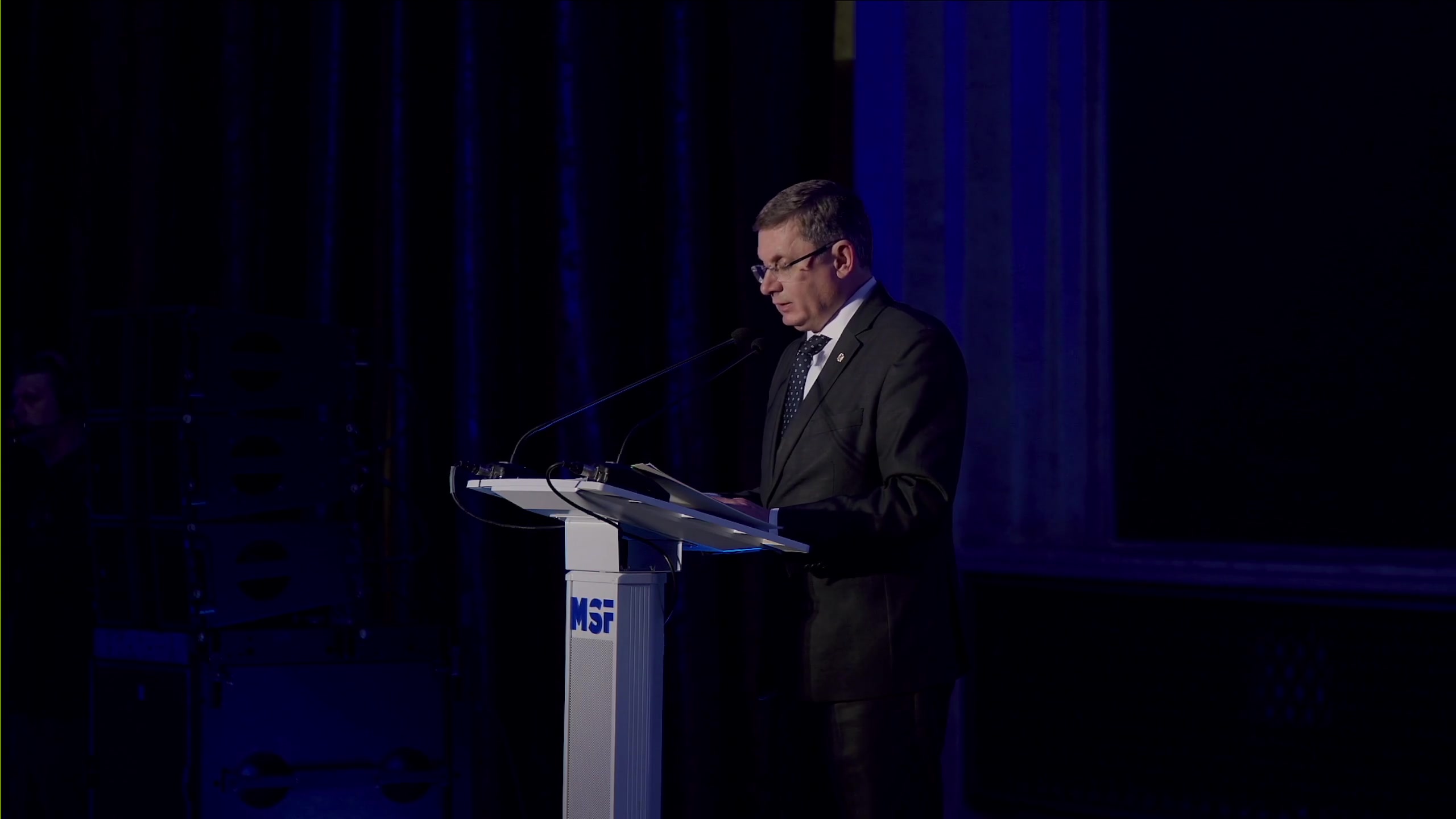
But it is also my honor to introduce here with us our honorary guest, Mr. Igor Grosu, who is the speaker of the Parliament of the Republic of Moldova, who will welcome us with a keynote address. Please.
[Igor Grosu]
Excellencies, dear colleagues, ladies and gentlemen. It is a pleasure to be with you at the Moldova Security Forum. This panel is about defense expanding, but before speaking about the budgets, I think we should remind ourselves what this money is actually for.
Russia's war in Ukraine has fundamentally changed the security environment around Moldova. We see that reality not only across our border, but also in our own skies. Since 2022, our national airspace has been violated on 88 occasions by missiles, drones, decoy drones, or their fragments.
50 of these incidents happened this year alone. Behind this number is a very simple question that people ask us: can the state protect us? And we have to answer that question honestly.
We cannot build the protection of our skies overnight. And we cannot compensate in four years for three decades in which defense was seriously underfunded. An air defense system is not something you simply buy, switch on, and consider the problem solved.
You need radars, you need equipment, you need trained people, communications, infrastructure, and procedures. All of this takes time. But four years are enough to start changing things, and that is exactly what we did.
In 2022, spending on national defense was below 900 million lei. This year, we are investing almost two billion lei. In other words, we have more than doubled our defense budget.
Of course, Moldova will not compete in absolute numbers with largest European countries, and that is not even the point. The point is that defense is no longer treated as a secondary issue. It is now recognized as one of the state's core responsibilities, and we can already see what this investment means in practice.
In 2023, Moldova acquired its first modern air surveillance radar. A second modern radar, financed with European Union support, is being added to our surveillance system this year.
On 27 August, during our Independence Day parade, Moldovans could see part of this transformation themselves. Modern military vehicles, new equipment, and capabilities that our army simply did not have several years ago. At the same time, after several years of enormous pressure on our democracy, we are also much better organized in defending our information space and our institutions against hybrid attacks.
Because Moldova has learned something very important. Today, a country can be attacked without a single tank crossing its border. Foreign interference, cyber attacks, illicit political financing, energy blackmailing, and manipulation of social tensions are also instruments of aggression.
That is why when we speak about defense, we have to think beyond the army alone. We're talking about the resilience of our state, the protection of our infrastructure, of our institutions, and our ability to respond to different kinds of pressure.
Ladies and gentlemen, there is also an important change taking place in our society. For many years, defense was sometimes presented as the opposite of peace or even as something incompatible with neutrality. The last four years have shown us otherwise.
We invest in defense because we want peace. And to protect that we have, we also need strong partnerships. For us, strong partnerships are part of our security.
The European Union has become one of the most important security partners our country has ever had. Since 2021, support for Moldova through the European Peace Facility has reached more than 300 million euro. This also includes the 120 million euro approved this summer for a medium-range air defense system.
Moldova is now the second largest beneficiary of this instrument after Ukraine. We have also built political frameworks that simply did not exist several years ago. In 2024, Moldova became the first country to sign a security and defense partnership with the European Union.
We concluded a new defense agreement with France. We launched a defense and security partnership with the United Kingdom. We have deepened cooperation with Romania, Germany, the United States, and many other partners.
This week here in Chișinău, our parliament hosted the Rose-Roth seminar of the NATO Parliamentary Assembly, bringing together parliamentarians, officials, and security experts from NATO and partner countries. For Moldova to host such a discussion today is itself significant. Yes, it is true that we are a neutral country, but neutrality cannot mean isolation. And it certainly cannot mean that Moldova should remain unable to protect itself.
Our task now is to build a Moldova capable of protecting its neutrality, its sovereignty, and the European future chosen by the citizens, by its citizens. We are not here yet. We need more capabilities. We need to continue modernizing the army.
We need better protection of our airspace, and this will require money, time, and strong partnership. But when we compare Moldova today with Moldova in February 2022, the difference is real. Over the last four years, we have started to close gaps that were left open for decades.
We have invested more, built new capabilities, and learned important lessons. Now we have to continue, and we will, by investing in the capabilities we need, by training our people, by using the support of our partners wisely, and by making sure that every additional investment makes Moldova better protected. Thank you.
Thank you very much. It's really an honor to have you here with us, Mr. Grosu. And it's good to continue this edition of having your presence at Moldova Security Forum and also discussing about the pressing issues related to security defense of Moldova and also of our region.
And right now, without further ado, I would like to present the moderator of our session, Robert Lupițu, editor-in-chief at Calea Europeană. Robert, te rog, mulțumesc.
[Robert Lupițu]
Good afternoon. Good afternoon, everyone. And thank you for showing resilience and being together with us here at the end of the first day of the Moldova Security Forum with a panel that, well, it discusses about spending, but it's about investment, security, and peace within the society and within the relationship between the state and the society. And I think the speech and the keynote speech that President Grosu of the Moldovan Parliament had was paramount in in this, and it will lay forward our our discussion that we will have in in this panel.
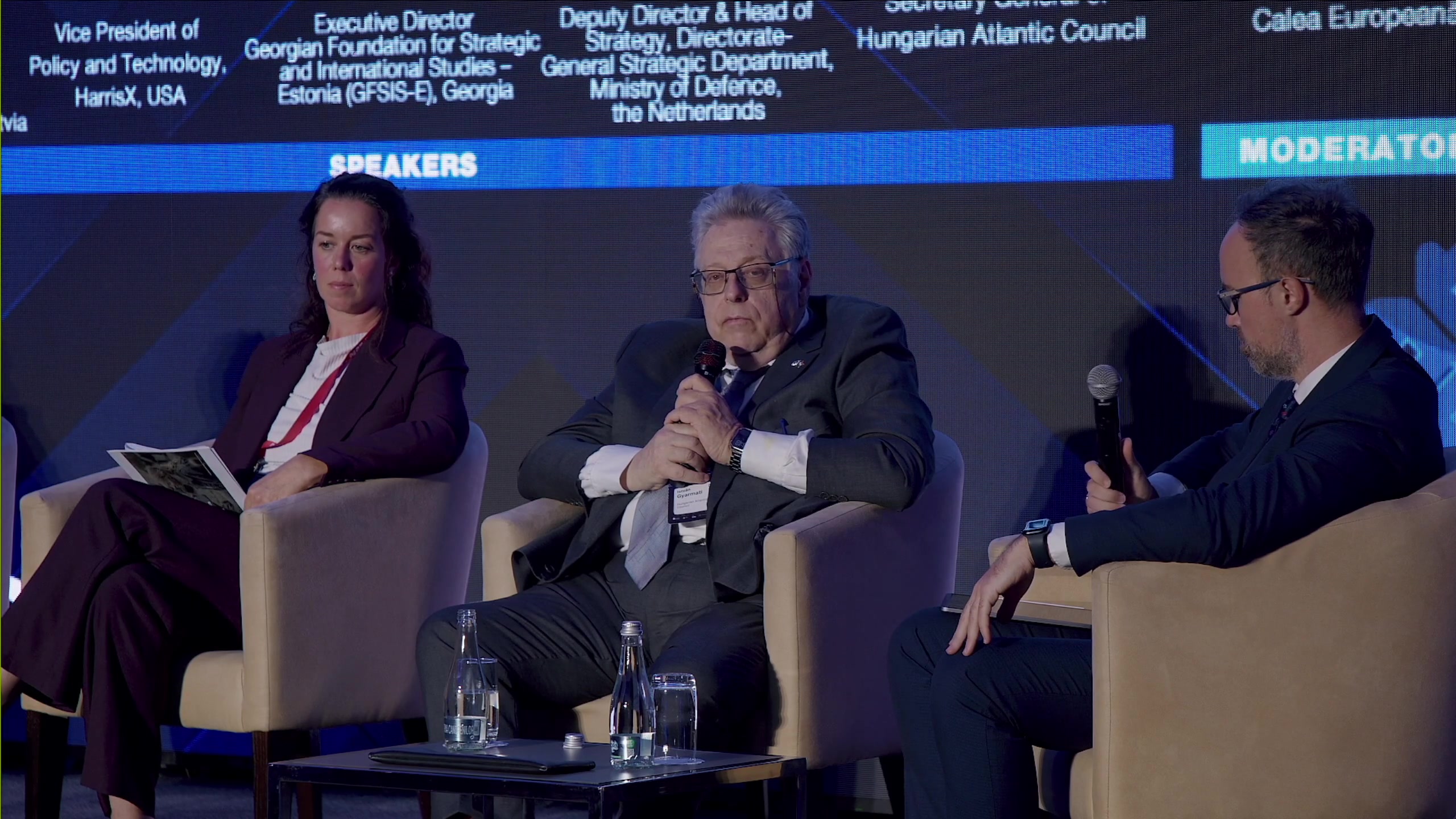
It's my pleasure and my honor to moderate for the third year in a row here at the Moldova Security Forum, and I always feel very, very welcomed. And I congratulate you for for what you are doing. And I must say this on a personal note, you are an inspiration for many think tanks in the region and for strategic food for thought. Without further ado, I would like to ask to join me here on the stage, our distinguished panelists, Mr. Andris Teikmanis, board member of the Latvian Diplomatic Association, former Chief of Staff of the Chancellery of the President of Latvia. Please, a round of applause.
We have together with us Mr. Zviad Adzinbaia, Vice President of Policy and Technology at Harris, the United States of America. Thank you. Please.
Next in line is Mrs. Ekaterine Metreveli, Executive Director of the Georgian Foundation for Strategic and International Studies. Please, and thank you for being together with us.
We have together with us from the Netherlands, Mrs. Marijne May Janssen, Deputy Director and Head of Strategy of the strategic department within the Ministry of Defense.
Thank you. And last but not least, Mr. István Gyarmati, Secretary General of the Hungarian Atlantic Council in Budapest in Hungary.
When I was thinking about the panel that we are about to dive in, I had a reflection and I would like to start with a simply observation as a citizen, not just as a journalist or someone that works as an expert, because we are discussing about how the society can handle the amount of disinformation that can come with a subject which is very sensitive. How do we also change our model in a Europe that was accustomed to peace, prosperity, well-being, and so on? And a few years ago, defense budget in much of Europe was a topic for specialists. And today, I think it's a topic that covers each kitchen table in each family because people are are are discussing how they feel the economic pressure, why national defense budget needs to be ramped up. And this is a subject that also President Grosu outlined in his in his speech on how we need to make sure that we can protect the society and the society to understand what's what's the threat.
And I believe that things like this are central questions for for these panels, for this panel, because in democracy, security is not only a matter of capabilities, it's also a matter of consent. And strong defense needs strong public support and strong public knowledge of of this. And we will discuss in this panel about three things: how government balances defense with economic and social demands, how to build resilience not only in terms of armed forces but across the whole society—I would call it as a keyword, preparedness—and how to keep public backing for defense spending over the long term, not just in moments of shock as we've seen in the last in the last year.
And we will start with the first round of questions, then we will move to the audience. And the first question goes to Mr. Teikmanis. We have Latvia and the entire Baltic region as a role model. They were first as the 2-percenters in NATO when NATO was about to expand its budget to 2% of GDP for each country. Now we have 3.5% and up to 5%. And on on this matter, Latvia has moved above this this ceiling and also has a direct approach with the society, considering that it has reintroduced military conscription. And from a country that knows very well the Russian threat, as Moldova does, but Latvia is is inside NATO, how did Latvia manage to build this political consensus and what would you tell Moldova about sustaining a consensus when the threat sometimes for some citizens feel distant, but for others this threat is is more pressing? Please.
[Andris Teikmanis]
Yeah, well, good good afternoon. Uh, indeed, very interesting topic. This is a topic about transformation. In last decades, uh, Europe has experienced enormous transformation. Uh, political geography has changed, uh, security architecture has changed. And after all these changes, we may we may ask again, well, are we back to, uh, Cold War 2.0?
I think most likely not. Uh, well, the security assessment has changed and and the warfare conduction actually also has changed. But there is a principle that hasn't changed since since Cold War. And that's a principle laid down by Winston Churchill when he said, uh, what, how we can deter or how we can avoid hot war by strength, uh, deterrence by strength and Western unity or today we we may say European unity. And that's what we really desperately need.
When NATO countries started to discuss a real issue of uh increasing defense spending, it was in Cardiff in 2014. Uh all the European countries went through quite substantial and different discussions. I remember even some topics uh rolled over Europe like um creative accountancy or creative budgeting uh when when politicians discussed what what else can be put under defense umbrella, what kind of expenditures. Well, we in Latvia has have gone also through similar topics and and when we are discussing our annual budgets and then questions arise, uh well, uh good education is also part of security, uh good medical treatment, uh proper roads, a proper the regional planning is also part of of country's security issue.
We we have discussed it and you can't avoid such discussion in democratic society. But at the very end, uh some kind of selection or or crystallization of of real priorities have come up and uh that was the base of fundamental decisions of Latvian government and parliament of uh reintroduction of conscription, compulsory military service, introduction of uh state security or or defense lessons program in in Latvian schools, uh heavy investment in in hard security in in raising of capabilities.
Um, developing of military infrastructure. And here, I I should say one of the best assistance, uh, and enablers was Russia. Uh, and especially Russian foreign policy, uh, very much supportive to, uh, expansionist and and imperialist, uh, aggressive policy of of of Russia. Uh, Russia deployment of new units along along its western borders, uh, different Arson attacks in Latvia and other European countries, uh, sabotage acts like like, well, we have mentioned already Leipzig and other places. Well, this all has strengthened the termination of of Latvian government, of Latvian parliament that hard security, and I'm stressing hard security, hard defense is priority number one and then others are following.
Uh, well, we we have increased very substantially, uh, our, um, defense capabilities. Uh, this year, we are spending 4.91% of of the GDP. That is 2.16 billion euros, uh, for our defense. Now, next year, it will be 5% round. Uh, and and we are planning to increase, increase this this spending. Uh, our next 10 years, we will, uh, we are planning to spend some 7 billion more, uh, on, uh, strengthening of capability of all kinds of capabilities, uh, including, well, Hymars, uh, rocket systems and, uh, self-propelled artillery systems. So we to to prove that, uh, well, the slogan "We will defend ourselves from the first inch," it's not only only words. Uh, we are ready to do it.
We we have changed the legislation so that, uh, our national armed forces are entitled to react, not waiting for the order from above, from the highest commander. Well, they can act immediately. That means that if somewhere, uh, some little green men may appear, then they will be eliminated by by, uh, our national armed forces, by by troops on the spot, not waiting for orders. So that that changes the thinking, that changes the assessment, uh, of of politicians, uh, and uh, that changes the the understanding of, uh, of the society in general.
Uh, well, we know that, uh, the aggressive policy of of Russia will continue, uh, in different kind of, uh, hybrid threats. Uh, but now, I think the thinking in Europe, the thinking in nature has changed if maybe 10 or 15 years ago, Russia as a major threat for European security was mentioned in in classified, uh, agencies documents. Now it's it's in all, it's it's clearly mentioned in all major policy documents. Well, the thinking, political thinking, political assessment has changed, has changed dramatically and and Russia is permanently giving good source to change this policy.
Uh, well, and it's continuing to use all possible hybrid threats. A week ago, we had, um, parliamentary elections. And just after parliamentary elections, well, Moldovans know pretty well what does it mean to have parliamentary election, how how widely different kind of hybrid threats are are being used to influence results of elections. Well, uh, we we saw the assessment of Latvian National Security Agency that said that actually, uh, the influence from abroad was close to zero, was very minor. Well, why?
It it's because Russians know that we are, we know that they can do something. We we know how to react, we are prepared to react, and and people have have gained much more critical thinking, uh, regarding, well, campaigns of disinformation or or deep fake or or all kind of of means that that are available or that are on the table. Uh, and, uh, elections was were, well, pretty calm, I would say, apart from what normal political debate and a normal political competition.
Uh, that's the reason why we should be prepared and and that's the reason why why society in general is is ready to support. Uh, last months, uh, one of the biggest internet media conducted a survey just about how how society is reacting towards the issue of 5% defense spending. Uh, well, 49 point, practically 50% uh, the answer was supportive. Uh, it's it's pretty high.
Uh, well, about one-third was was skeptical about this, but it it shows that that there is a broad consensus, uh, among all the major political forces. Well, we we we have also some, uh, parties that is rather strongly linked to to the, uh, opinions coming from Moscow. They gained about 15 seats out of 100 and and they have zero influence on on political decision-making process. So, Latvia will go ahead. Latvia, uh, will do what what what what is as as rightly the here Romanian Defense Minister said, "Well, we we don't forget about Article 3, not only about Article 5." Uh, we are are ready to to strengthen our defense capabilities.
[Robert Lupițu]
Thank you for that and I want just to add a thing this this time as as a journalist, not just as a moderator. Uh coming from both of us from a NATO country, this is a NATO country mindset and we worked a lot to see that prior Article 5, we have Article 4 and Article 3. Uh but when we refer to a neutral country like is the Republic of Moldova, uh that has a different, a different mindset, the Russian enabler as a as a defense threat, as a whole society threat is over is there, but the way the society perceives it probably is more different than it's in somehow in our in our countries. And I want to link it uh to the next question to Mr. Adzinbaia because um seeing uh the President of the Parliament here Igor Grosu discussing about defense spending, it's actually the link between society and decision makers because it's not just only the Defense Ministry that discusses this, is the legislature, the parliamentarians that are directly elected and they have a direct link with the society throughout the very foundation of democracy, which is the vote. But vote happens with perception.
And Mr. Azinbaya, you work, uh, your work focuses on public opinion, information and uh integrity and therefore uh countering information manipulation. Um, I want to ask you what's your take on how much citizens in democracies are willing to pay for defense, not just in military terms? And which messages, like, I don't know, security, jobs, technology, uh, or protecting social spending actually move public opinion when you analyze this?
[Zviad Adzinbaia]
Thank you, thank you very much. Um, a couple of things to talk about. I will talk about um our latest research we did across 11, uh 13 European countries and the United States with Globsec a couple of months ago, and I think the findings are um quite fresh still for this conversation. Um, there's a difference between willingness to support, for instance, increased uh defense spending, and then actual preparedness, which is the conversation about resilience or preparedness as a core component of resilience. Um, if you look at um each European country that we surveyed, um which pretty much includes NATO's entire Eastern flank, uh Germany, UK, France, and the United States, um you will see that support uh and willing willingness to increase uh, let's say so, uh we were wondering how much people are prepared in case of an attack to defend their country or to contribute as a citizen to that defense of 62% of total population say that they're willing to support their country, support their armed forces or themselves uh against an imminent attack.
Now, if you ask a subsequent question, if you're ready to do so, it drops to 34%. If your country is ready or not for such an attack, it goes to 40%. Uh, these numbers can be explained uh quite clearly. One, well, no one wants to be invaded, uh, and no one a household, a voter, a teacher, a scientist is willing, but is ready in the morning to just drop a scientific job or a diplomatic job or a medical job and fight.
But we had this conversation earlier, you know, when something actually happens, that's when the willingness is actually tested. There are some encouraging numbers too when it comes to uh what the citizenry um across Europe, uh east and west and in the United States support. Um, one of them is defense spending. Um, there is not a problem in terms of citizens' willingness, especially after they've recognized the increased relevance of defense and security and safety uh in in the presence of Russian aggression, in the presence of uh re-thought and redefined uh geopolitical order.
Uh, the numbers range from 70s to high 70s, sometimes at 80s when it comes if you ask a citizen uh in France, if you ask a citizen in Latvia, if you ask a citizen in Poland, especially Poles, for instance, uh if if there is anybody here from the Polish government, um they should be proud that their citizens are uh pretty much an outlier in terms of uh among I think every NATO member country, an average Polish citizen is higher in likelihood to support increased defense spending, to support Article 5, to support more arms, to support more support to Ukraine, so on and so forth. But support in general across NATO countries and European Union countries um is quite high. Now, the key puzzle to interpret some of these numbers for policymakers is this, as you said and suggested, you know, what are some messages? As we all know, especially the ones who conduct uh global polling and public opinion polling and analytics, um the key puzzle is to not corner a voter and make a voter choose between living and investing, between being educated or between having uh health insurance and defense.
Because if you put a voter, an average voter and working person in that difficult situation, he or she has to make a decision which might not contribute to national defense, but something that is quite casual and quite real, which is school for my child or uh uh Raptor 22 in my defense forces that might do or not uh uh contribute uh to my country's defense. And I think a smart policy uh is to not create a sense of an ultimatum when it comes to voting, when it comes to engaging with your citizens that, you know, we'll cut it from your social welfare, we'll cut it from your education. No, there has to be some kind of balance where citizen feels encouraged. You know what, I will pay more for this um because I now recognize more um uh that my defense is my everyday need, like my education, like my safety. There is another metric to see, sometimes we hear uh uh political messages that there is a uh transatlantic rupture.
That rupture is not shown in public opinion actually. Uh public opinion across the Atlantic is quite stable and quite high when it comes to points of convergence. Um, for instance, support to NATO, 69% if not if I'm not uh mistaken of US population consider NATO uh vital for American security. And the support for NATO in general and America staying in NATO is uh more than 70%. Um, Americans equally recognize, for instance, sometimes we might see messages, a critical messages coming from the White House that US is spending uh more than US is supposed to.
That actually reflects public opinion. One could deep dive and see what US is spending uh uh for NATO uh versus uh for its other purposes globally, but it reflects US public opinion. I think I would I would recall uh 65 to 68% of Americans believe that uh US is paying disproportionately more than other NATO countries for common defense. So I think those figures, but at the same time, uh if you ask European voters whether Europe would be secure and safe without US support and military involvement, at least in the present level, uh the confidence at 50/50. And if you ask European voters whether US role is crucial for European security and defense, confidence is at 75%. So Europeans recognize it quite well.
[Robert Lupițu]
But it also depends where you ask. If you ask this in France, well, the numbers might not get well, but if you ask this in Romania, Poland, on the Eastern flank, uh the support might might get higher.
[Zviad Adzinbaia]
It gets higher, but I would not say support for NATO or support for US role in NATO is particularly borderline in France. It hits upper 60s, um, including in Germany. We see some political differences or domestic political differences when it comes to relationships with the United States, but this is pretty much in voters' mentality decoupled from uh some existing tariffs or political messaging. So the numbers I give you are actually average when I tell you that 75% of European voters uh uh consider US role in in European security and defense, it's an average.
Uh in Poland, I think it might hit 85%, 86%, so on and so forth. But uh uh numbers are not fluctuating too much. We can deep dive in some other numbers um when it comes to alignment between citizens um and their governments. But it is crucial to think about uh public confidence right now because then that becomes a huge issue when governments go back to voting uh processes and sometimes they're uh they're uh surprised that their voters have expressed rage towards them because um uh uh but this is very simple and explainable. Uh when we measure GDP, when we measure defense investment, when we measure political metrics and statistical metrics, we sometimes forget to measure the voice because all countries we discuss are democracies and you cannot have this measure forgotten.
[Robert Lupițu]
Thank you. And I think this is a good line to take uh to take with us that uh we forget to um see what actually the society wants or is uh is thinking uh on that. We also had yesterday uh a poll, a study released uh on the eve of the Moldova Security Forum discussing about risks and vulnerabilities to Moldova's security and corruption and poverty, um, comes exactly on top. So it's not external threats or things or other things like that. And this is why we have a discussion a discussion on how important is to um bridge the gap between the way the society perceives the risks and the responsibility that the authorities have to protect the land but also the citizens that live in the respective land.
Um, I know that the Republic of uh and Moldova and Georgia uh share uh good food and good wine, but they also share um the same experience with Russian threat and I would say occupation. Uh, we know what happened in Georgia in 2008 and everyone refers to this as the start of what Russia did in Crimea and afterwards in the entire Ukraine, but we tend to forget about Transnistria and what happened at the end of the cold of the Cold War. Um, and I would like to ask Miss Metreveli, the next thing when it comes to Georgia's experience, uh, but from a societal resilience approach, uh, what does your experience show about what happens to public attention and public support, uh, when it comes to defense readiness but in terms of societal resilience, not military actual threats? Um, and how do people nowadays in in Georgia perceive this?
[Ekaterine Metreveli]
Um, thank you. Thank you to organizers first of all to our Moldovan hosts for um inviting me and it's a pleasure to be here for a Georgian talking at the security forum in Moldova in this very important for Moldova times. I want to add up one um quick note to what Zviad was talking. We should be, I'm a Finnish honorary consul also in addition to being from Georgia, and I'm really, you know, proudly mentioning all the time that Finland's opinion poll, and I hope I'm not mistaken and remember correctly, it's 86% of readiness, even without knowing the outcome of the war of the and that is the, you know, example of the societal resilience.
Um, so about the Georgia and Moldova, we really do share a lot and this is the Russian troops on our soil without the, against our will. It's the hybrid warfare that has been, um, carried out against our countries for, you know, since they were independence. And, um, it's also, I think, understanding that defense is not only about the, um, armies or about the money even. So let me begin a little bit further away, but I won't take lot, I will be brief.
Um, in 2008, so this was a decisive moment. Though our occupation started, you know, long much earlier in 20 to 23 and, you know, my compatriot can, you know, share this with me. Um, and in Georgia in 2008 at Bucharest Summit, Georgia and Ukraine were promised to get a membership, but this was a promise without a pathway. And within four months, the Russian tanks rolled into the Georgia. So security declared but not invested is, you know, it's just air, it's nothing. And it took a while for Europe to, you know, learn that lesson and now we see this, um, as mentioned here, the defense budgets increased, which is, you know, welcomed.
But behind each defense budget, there is a societal consent and that makes the societal support also a defense capability, if we can say so, and which is a targeted, which is targeted by our adversary. And across Europe, despite this, um, good numbers which we have showed with us, there are, um, same type of messages, same kind of messages spread. Um, and the the goal of those messages is not to win the debate whether increase the budget or not, but it's to create the cracks and the to, you know, make those cracks wider. And different countries are responding differently, and we are talking about democracies here, of course. And every country, there are the fault lines which have been, um, you know, there for years and decades and they have not been created by Russia.
These are generational differences, these are differences across the regions which we have just seen, also, you know, political parties, mainstream or, you know, more radical. But Russia, what what they do is that they learn, they study well those differences, they amplify, and then they kind of exploit. And this is, uh, this is a threat that all our society should be aware of. And Georgia is a case where this process has, you know, we have seen how far this process has gone because we have experienced all tools of Russian hybrid warfare. We have the hard security, the occupation has been there, uh, borderization, moving defense, iron fence deeper into Georgian territory, but what worked and what proved to be more effective, that has been really, uh, usage of those differences and the fears.
Um, the disinformation, um, disorientation, fear of war, um, targeting every topic which had a nationwide consensus. And it came kind of gradually step by step, and what we got is that, um, we observed the collapse of, um, you know, democratic resilience in the country. And that happened not because the Georgian people have changed their mind. There is a recent poll from 2026, and that has been happening consistently during the years. They are, they see their future in the Europe, and they see the European Union, Euro-Atlantic integration as they, you know, pass for their development.
But what has been happening, the channels through which the majority will can be transformed into the policy has been, you know, monopolized. So what, I I'll just conclude with one thing, the lesson which I want, um, to share with my Moldovan colleagues as well as the European Europeans, I'm part here of a GMF organized study visit. So for two days here, my colleagues, um, we have been meeting different public officials and I'm really, you know, admiring this, uh, vigor that the elite has, uh, in their determination to take country to the EU.
Um, but it's very important, um, timing is very important. Okay? We were given promise, we were, the door was open, but we were not let in. Okay? And the gray zones, um, these are not good for, um, Europe. And, um, whenever there is a gray zone, Russia uses them, you know, quite well and we should know that. And then, um, if this opportunity is missed, then it would be much more difficult to then get the societal support.
[Robert Lupițu]
Thank you. Thank you very much for um, for your intervention and for sharing uh the Georgian perspective. We know that the society over there is uh still feeling the European spirit to put it to put it this way. Uh, I would like now to move to Mrs. uh Mrs. Janssen from the Defense Ministry of the of the Netherlands. Um, and I recall your former prime minister, now NATO Secretary General at uh a debate in the European Parliament saying that for for many, many decades, we have um focused ourselves in social benefits while neglecting uh defense spending. I would actually prefer defense investments because spending sounds like something bad, but investments um have, let's say, a good a good projection. And we know that the Netherlands now it's moving from those decades of post-Cold War cuts to rearmament.
And from your perspective working in a ministry, so in in the government layer, uh how do you decide priorities when, let's say, money is finite? And we know the mindset that the uh Dutch society has um in this way very, very balanced. Uh and how do you explain those tradeoffs of needing to to invest in in defense to the public, but also to the parliament considering that parliamentarians, of course, might have other opinions when they discuss with with voters?
[Marijne May Janssen]
Thank you. That's many questions in one. Let me try to tackle each one of them. Thanks. Um it's good to be here. It's good to be back from the geopolitical holiday that we've been on for a long time that you referred to. For three generations, maybe. Absolutely. Um so first in terms of budget, when I started working at a um uh defense organization, I was a reserve officer, that was 2014. Budget cuts were still happening. Uh all people 35 years and older were laid off. Uh we were still having a decrease.
Uh since 2018 until now, we've been rebuilding, we've been growing, and we're sort of back at the same level that we were then. But now we really made a big jump in our latest defense white paper. That's what me and my team are responsible for. Um, and there we make explicit what we need to strengthen, why and how we intend to do it. Um, and also what is unique this time is that we um have the parliament to agree to spending uh beyond their term. So we have spending in order until 2035, including uh growth of the army in terms of people until 200,000 people. We came from 60,000, so that's really a big leap uh that we try to make our organization ready for to also train them, to equip them, to house them.
Um so we need to do all that. And then one part of your question was also how to prepare the parliament and the wider audience society, right? And the society, exactly. Yeah. Um we ask a lot from our society. We are not bordering Ukraine, we are not bordering Russia. So we've come from very, very far. Um but even in the Netherlands, we have drone incidents, we have a shadow fleet passing by, so, uh, geopolitical reality makes it easier for us at the ministry to explain what's going on and why the society needs to change.
Then Secretary General Rutte also helped us a lot by cutting the 5% into 3.5 and 1.5. 3.5% is for um, Actual defense spending. Actual defense spending as you explained earlier. Uh the 1.5 is for society. That helps a lot in telling our story. It's for strengthening bridges, it's for um educational purposes. Um so we have another ministry, uh or it's a coordinator for terrorism and safety, and they control the 1.5. We as the Ministry of Defense do not touch those percentages. We can advise, we do advise about it, but we stay away from it. So that's for society.
But then we have another line, and then I will finish. But um we also think and we offer uh win-win opportunities for both defense uh and Dutch society because we cannot simply do it alone. So we need to strengthen the resilience and we can do that by offering trainings, um making or offering them to be reserve officer, reserve soldiers. We share our spaces if possible, so they can people can train, do sports at our uh uh what we do not use at our spaces. Um so we try to co-create, we work together with industry to make it um uh feasible and attractive for them to also do long-term planning, um uh innovation, and upscaling, upscaling uh the industries. So yeah, we look for win-win opportunities. Yeah.
[Robert Lupițu]
Thanks. I I noted the way you explained the 3.5 and 1.5% that goes to education and preparedness and resilience, and this is partly because you did your your homework with infrastructure when it was the moment, because in our part of Europe, the 1.5% is very much focused on infrastructure, military mobility, dual use, um, infrastructure and and so on, not only not only the part of preparedness. But I think it's a good note to prepare the society, and it's also a thought that I had in a debate in in Romania that also there is a need to restore the credibility and dignity and also part of proudness to put it this way, to wear the military outfit, actually to be to be in the military for the part of the young generation.
Um, before moving to questions, I encourage you to prepare them and also to use to use Slido. Uh, we have also Mr. Gyarmati, the Secretary General of the Hungarian Atlantic Council. And uh, we know that NATO allies do not all of them perceive threats in the same way or respond uh to them with some urgency. We can look it in our region, but we can also take the difference between Southern Europe and and Eastern Europe. Um, how does this affect uh NATO and EU cohesion? And I'm asking this because there are countries like the Republic of Moldova who are neutral but wants to join the European Union also as a security guarantee as President Maia Sandu said this morning in her speech. How does this different of different perception when it comes to threats affect the cohesion between NATO and the EU? And what is the risk of having a two-speed Europe on on security?
[István Gyarmati]
I thank you very much. Uh, before I answer your question, let me make a few points as I I have which is an answer to your question question as I don't have an hour. Uh, I just five minutes. So let me make some points. My first point is that we need to to interpret our decision about the 5%. When the decision was taken, it was a political compromise. We did not compromise on the number, but we compromised on the period of implementation. And that was the price we had to pay to accept uh this decision. But since the decision was taken, the situation has changed. We do not have 10 years to implement. We might not have even 10 months. So I think we really need to rethink how we implement it if we implement it the way as many countries today think, and this is affecting the cohesion, uh that means that in the first five years, we do nothing, but then we we will do the last year the 5%. Uh then it decision is is reduced to not to nothing. So we have to act quickly and we have to to take into account that uh what's not done now, we might not be able to do uh five years from now. Second point is that uh politicians love to talk about uh percentages of GDP, but the most important thing is not whether it's four or five, but what do we spend it for. And there is very little discussion, uh political discussion. The military is working on this, but they don't have political guidance. So I think the the next point is that we must make uh an appraisal how we spend it, what do we spend it for. And we do not spend it for only for heavy weapons which politicians love to have new tanks and new aircraft, but we have to spend it for many other things, from drones to to air defense. But one more thing, uh which we do not mention. As the Russian warfare is changing, Russia is will not send thousands of tanks and aircraft to NATO territory if it comes to a a conflict. It will send drones, but not necessarily against our armed forces, but against our infrastructure, civilian infrastructure.
And my question is, is are our societies ready to live with this for days, weeks, and months? And my answer is no. Uh, the biggest damage that was made in the past 20 years was not the reduction of defense capabilities. The biggest destruction was in the attitude of the public opinions to war. If you look around Europe, Western Europe, it's 15 to 30% of the population that is ready to fight for his or her own country, not a NATO ally, his or her own country. And the Russians will use it. They will challenge, they will test our resilience. Therefore, we have to spend money and effort and talk about it openly, which we don't, how to increase the resilience. We have to tell the people what they can expect and what what could be done and what we should do. My third my my third point is that, and that's my last point because I have only five minutes. My last point is that we have to live with a newly uh defined United States, and it's not Donald Trump. Uh we might like or dislike Donald Trump, although I think liking him is an extremely big challenge, but uh whatever we think, uh the Trumpism will remain in a maybe a different form, but it will remain with us. It's not isolation.
If we take it at the end, this is making America not necessarily great again, but responding to the real challenges that America has to face. And these are in Asia, not in Europe. And we have to accept that the Americans will focus uh according to the pivot to Asia, which has not happened, but it's happening now. Uh uh they will focus on Asia. And therefore, I think I, first of all, we have to accept that the Americans will to a large extent leave Europe and not dream and about that they don't and not fight it that they shouldn't because they will. But what we should do, I think, we should present our situation in a different way. We should not whine and cry and shout about Americans living. We should tell the Americans, look, uh we are ready to help you.
We are ready to help you that you can get a bulk of your forces from Europe to Asia to defend your where your interests are. You want to withdraw, Mr. Trump, 5,000 soldiers from Europe? Do triple of it. But when you do it, coordinate with us and leave here what we really need because we are ready to replace what we can and present a credible plan how we will replace it. Uh and it's not only money, it's capabilities. We should talk about capabilities in the first instance. But we need American capabilities. So we free up half, two-thirds of your forces in Europe, but we need uh some of it. We don't need your heavy equipment, we don't need American boots on the ground in Europe, but we need a lot of things from America that we cannot replace. Uh and therefore, we should strike a a new relationship with America. Separate defense from ideology. Uh the Americans Donald Trump might speak, might think about the freedom of speech different as we do. Uh separate it from economic competition because that's a normal thing in in in life. But defense, I think we we need to come up with a with a big deal, a great deal with the with the Americans. Now, how does it affect the cohesion? The cohesion of the of the alliance has never been 100%. And it's understandable if you talk about Russian threat, why do we expect the Portuguese see this threat the same way as the Latvian see. They will not. They don't. They will not. So, uh and that's the problem is that this difference has been multiplied in the last decades because we were not talking about real threats. And now uh they do not see the threats. And you you you have people, politicians, I don't want to name a Spanish prime minister for instance, who who basically denies that there is a Russian threat. So we need to to work within the alliance and also outside the alliance uh in order to explain that the threat is real, not less dangerous than in the times of the of the Soviet Union.
Stalin uh was not more dangerous than Putin. Uh in some to some extent, Putin is more dangerous than Stalin ever used to be. So, I think we we really need to work on on the cohesion, not just talking, we need to talk to each other, but to showing what is the real situation and why we need to strengthen resilience, not only military, but political and societal resilience. Tell the the Portuguese, the Spaniards and others who who are far away from the from the front line, which will not exist because it will be a different war, that drones can strike Lisbon as much as they can, they can strike Riga. My last point is that that we need a real dialogue within the alliance, not a polite dialogue, not a political, so to say, dialogue. Political dialogue meaning that we we do not address the real issues, but we try to find compromises. We should not shy away from from big heavy discussions which we do not have on the political level. So I think we we really need to rethink our our approach uh in many respects, much more deeply than we were ready to to admit until now. We have two people who help us very much, Mr. Putin and Mr. Trump. They will force us to engage in a in a dialogue and to make real efforts because if we don't, uh they will do what they think they should do on their own and that will be a disaster for Europe.
[Robert Lupițu]
Thank you. Thank you very much. The main difference I guess between uh Mr. Putin and Mr. Trump is that uh one of them, the first of them is a is a threat to democracy and our countries. And the other one is the president of a natural ally based on values, but nowadays to quote President Stubb of Finland, it's an alliance of values that works primarily on common interests. And probably this is the word that we are trying to find together. Uh I would uh before moving to the audience, I would take one one conclusion from your from your uh intervention and thank you. The fact that maybe discussing about numbers, 2%, 3.5, 5% is actually hurting not helping the debate. Uh because it's not about percentage that we use, it's about things that um that we need as capabilities, uh military ones, but not only military ones, cyber society and and so on. Uh we have two microphones, one over there and one over there. I would uh like you to raise your hands. Okay, we have two over there. Please present yourself and tell to whom you do address the the question. We have something like 20 minutes for questions. Please.
Alright, thank you very much. Axel Hagelstam, Finland. Um, I'd like to get back to the the issue of 1.5% that Marin was talking about already and actually reflecting on the the conversation we just had whether defense spending is at the cost of of other um non-military capabilities. And I would make the argument that yes, but not entirely, because the one and a half percent is designed and meant to strengthen um the ability to maintain non-military capabilities so that we can make sure that our civil societies also survive during the conflict. And I'd like your views on what this one and a half percent should contain because currently, as a matter of fact, it can contain pretty much anything. Thank you.
[Robert Lupițu]
Thank you. Maybe Miss Janssen, you want to jump in on this one and then we will move to the last question.
[Marijne May Janssen]
Yeah, I think the 1.5% is actually very important that me as a representative from the Ministry of Defense does not have any official opinion on how it should be spent. But yes, we heard about military mobility, healthcare. Um we have a civil reserve officers, so they are not officers but it's like civil civilians doing extra stuff, being prepared to do something when an alarm goes off and to help their neighbors. Uh we can put a lot of money into that, into to training people to do the stuff that is non-military but uh adds to the Article uh three resilience. Um and then one more thing I wanted to add because I don't get more time is that uh we need to learn to think in effects, not not in terms of money or percentages, not even in terms of capabilities because then we also have to explain why do you buy a tank or a frigate or a drone. You need to talk about which effects you want to uh uh have and then there's many ways to reach many ways to reach them. And I think that's also something we should explain. That doesn't answer your question, but I wanted to add that. Thank you.
[Robert Lupițu]
Alright, thank you. I'm Jakub Urbaniak. I'm working for the External Action Service, but actually I would like to ask the question as a European citizen and a father to a 11-year-old boy. Uh Mr. Gyarmati mentioned this, we speak a lot about more uh spending or more investment in defense. All fine. We have an understanding. This is a question of money. Then we speak that there is 28% for example, Hungary, in other countries, I can imagine it's a little bit higher, but not necessarily this higher. How actually we get people to be able to serve? What incentives we provide them that they think that it makes sense to actually serve in the army or something supporting the army? And is there an alternative to a draft? Why I was mentioning the draft because we all say that Finland is a great example of a country where this all of society approach works. That's the country where actually everybody goes through the military service. Thank you.
[István Gyarmati]
I think that's a normal question that everybody, everybody asks himself. The real question is, is how to increase these numbers? Because this the 28% for me, it's not a fact. It's a failure. It's a real failure. And it's a failure of the past 20 years. And uh I think we have to talk openly. We have to tell the people the truth. And we have to use the civil society. We don't have this, it cannot be a governmental propaganda. It has to come from the people and to the people, and we have to convince each other. We are not convincing each other, and that's the point where it's a failure. Because for me, it's not acceptable. And if it's not a draft, and I don't believe in the draft in in in our part of the world, I don't think it would work. Uh then we have to we have to make it uh uh more appealing. We have to make it appealing for people to go. And there is a lot of things how how we can do it. The problem is that today's politicians, Western European politicians, do not have the guts to do it.
[Robert Lupițu]
Thank you. Thank you very much. Uh before ending the panel, uh in one sentence, one sentence from each one of you, what is the one thing that governments must get right to have public support for defense spending over the next five years? Mr. Gyarmati, please.
[István Gyarmati]
I can repeat myself very shortly, tell the truth.
[Robert Lupițu]
Tell the truth. Thank you.
[Marijne May Janssen]
I think we should continue sharing our knowledge and not underestimate our societies.
[Robert Lupițu]
Thank you. Please.
[Ekaterine Metreveli]
Um I'll also repeat myself for me the probably the most important is to have a trust that the government should generate a trust.
[Robert Lupițu]
Trust.
[Zviad Adzinbaia]
Um make it easy and make it real.
[Robert Lupițu]
Easy and real. Thank you.
[Andris Teikmanis]
To get the trust from from society and and persuade society to to to be ready for actions.
[Robert Lupițu]
Thank you very much to our distinguished panel and thank you, President of the Parliament, Mr. Grosu, for staying till the end of the panel and thank you everyone for making this conversation very, very fruitful. It was a pleasure to have this panel and please remain in the hall because we will have a book launch after this this panel. Thank you very, very much.